How to structure an investor pitch
By Léo BarcetPublished 5 min read
An investor sees a lot of pitches. They do not remember the most complete one; they remember the one they can retell to their partners the next day. That is what structure is for: making your project easy to repeat.
The seven-beat outline
This is the order I recommend for a pitch of 3 to 10 minutes. The shares of time are guides, not rules. The outline fits every format: you shorten each part, you do not remove any.
| Beat | The question you answer | Share of time |
|---|---|---|
| 1. The hook | Why should I listen? | 10% |
| 2. The problem | Who suffers, from what, and what does it cost? | 15% |
| 3. The solution | What do you do, concretely? | 15% |
| 4. The proof | What shows that it works? | 20% |
| 5. Market and model | How big is it, and how do you make money? | 15% |
| 6. The team | Why you? | 10% |
| 7. The ask | What do you expect from me, now? | 15% |
1. The hook
The first ten seconds decide the rest. Three openings work almost every time:
- A scene (invented example): "Last Tuesday, Claire, a nurse in Lyon, spent 47 minutes looking for a free bed for a patient."
- An uncomfortable figure, if it is verifiable and you say it slowly.
- A question the jury is already asking itself, provided you answer it straight away.
Avoid: "Hello, my name is… and I am the CEO of…". Your name is on the slide.
2. The problem
This is the part most often rushed, and the most important. An investor does not buy a solution, they buy the disappearance of a problem. Make it concrete: one person, one situation, a cost in time or money. If it takes more than thirty seconds to understand the problem, it is not yet clear enough in your own head.
3. The solution
One simple sentence first, without jargon: what you do and for whom. Then a demonstration, or at least a picture of what the user lives through before and after. Resist the urge to list every feature: one, well shown, beats ten mentioned.
4. The proof
Revenue, active users, letters of intent, a signed pilot, month-on-month growth: whatever you have that is most solid. If you are very early, the proof can be a test, customer interviews, a waiting list. What matters is a sign that the market responds.
5. Market and business model
Avoid the big global figure lifted from a study. Show instead how you calculate your reachable market, from a number of customers and a price. Then say clearly who pays, how much, and how often.
6. The team
Not a CV: the reason this team will succeed where others would fail. Experience of the problem, a rare skill, access to the market.
7. The ask
The amount, what it finances, the milestones it allows you to reach. Then a closing line that sums everything up in one image: it is the one the jury will repeat.
Write for the ear, not for the slides
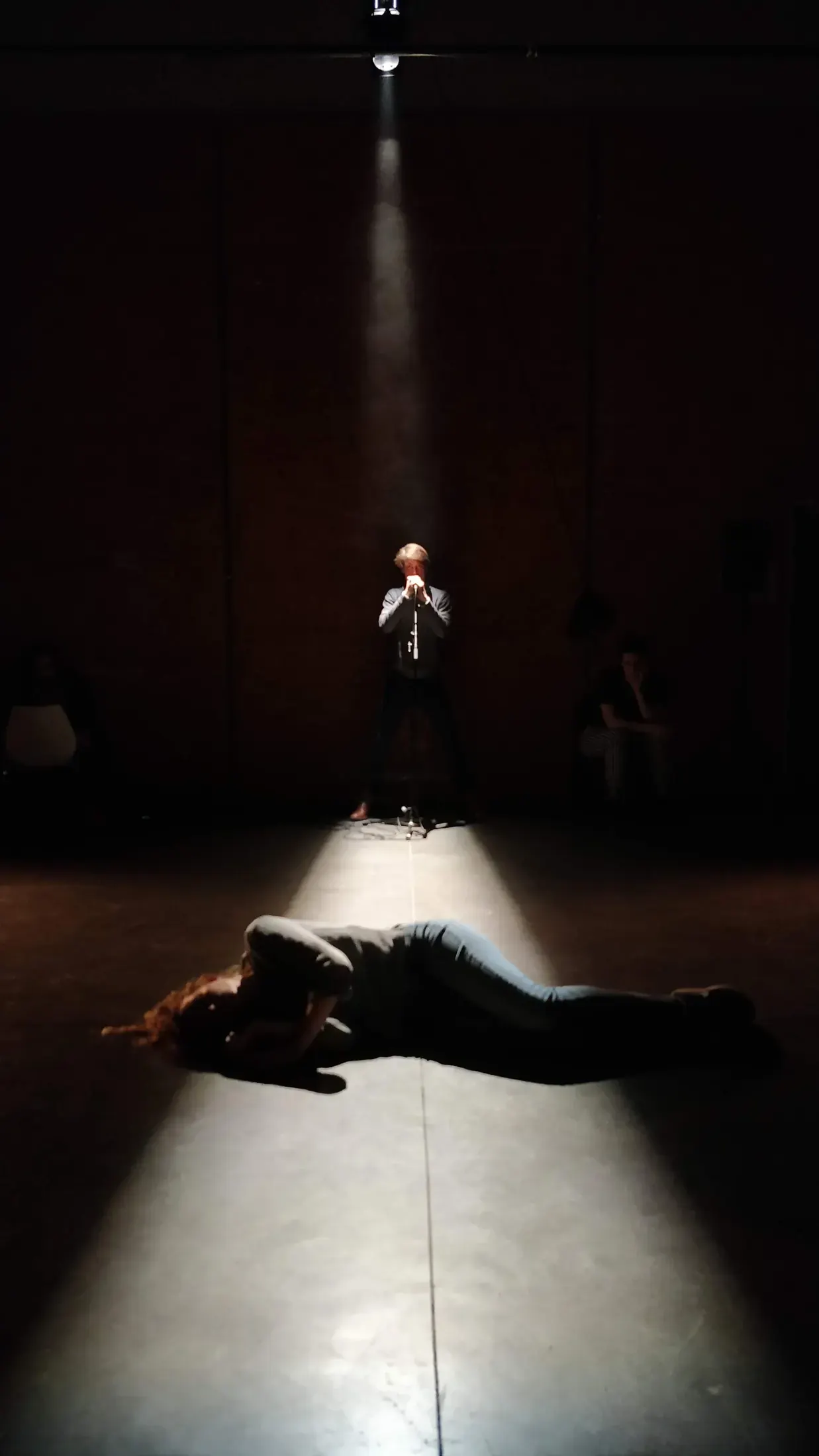
A pitch is a text that is spoken, not a text that is read. In the theatre, you write differently for the stage than for the page, and it is exactly the same here.
- Short sentences. One idea per sentence. If you need to catch your breath in the middle, cut it.
- Concrete words. "We optimise flow management" says nothing. "We save nurses time every day" can be pictured, especially if you can put a number on that time.
- Deliberate repetition. On paper we avoid it. Out loud, it serves as a landmark. Repeat the promise at the start and at the end.
- Written silences. After an important figure, stop for a second. Note it in your text:
(pause).
The S.C.E.N.E. method
This is the thread I follow with my clients. The structure described above is the first beat; the next four bring it to life.
- Structure: we clarify what you want to obtain, then build the story that leads there.
- Charisma: posture, grounding, eye contact, voice. The actor's techniques that give presence, without playing a part.
- Emotion: figures inform, stories persuade. We find the story that makes your project obvious.
- Natural: we rehearse until the text disappears. You no longer recite, you speak.
- Execution: we practise in real conditions, tough questions included.
Five mistakes that lose a jury
- Starting with the product. Without a felt problem, the solution falls flat.
- Reading your slides. The jury reads faster than you speak: it has finished the slide before you. The slide supports, it does not replace.
- Speeding up under stress. The pace rises, the voice too, and the message gets lost. Slowing down is almost always the right correction.
- Burying the ask. Too many pitches end without saying what they expect. Be explicit.
- Ending with an apology. "Sorry, I went on a bit long." Your last sentence should be your strongest.
Once the structure is in place, prepare what comes next: the questions investors ask after the pitch. To see how a coach can help with this preparation, read investor pitch coaching: how to prepare.