How to prepare a demo day or competition pitch
By Léo BarcetPublished Updated 3 min read
End-of-incubation demo day, regional competition, a support network's panel, an accelerator selection: the format is almost always the same. Three to five minutes, a stopwatch, and judges who have already heard twenty pitches before yours. Here is how to prepare for that precise format.
What a panel really remembers
Put yourself in the judges' place. It is 4 pm, and yours is the fourteenth pitch of the day. What they retain:
- A clear idea, which they can sum up in one line on their scoring sheet.
- A person, who carries the project with conviction.
- A moment, an image, a number, a sentence that stands out.
What they do not retain: your feature list, the details of your tech stack, your five-year forecast.
The outline of a 3-minute pitch
| Moment | Length | Content |
|---|---|---|
| Opening | 15 s | A scene or a number that sets up the problem |
| Problem | 30 s | Who, what, what it costs |
| Solution | 40 s | What you do, shown rather than described |
| Proof | 30 s | Traction, customers, tests, partners |
| Market and model | 20 s | For whom, how big, how you make money |
| Team | 15 s | Why you |
| Ask and close | 30 s | What you want from the panel, a line that stays |
For five minutes, lengthen the proof and the market, not the opening. For how many slides to use, see how many slides a pitch deck needs.
Write short, write to be spoken
Three minutes of speech is about 400 words. That is very little. Every sentence must earn its place. Run your text through a filter:
- Does this sentence help the panel understand or believe?
- Could it be said more simply?
- If I cut it, is something missing?
Rehearse as if for an opening night
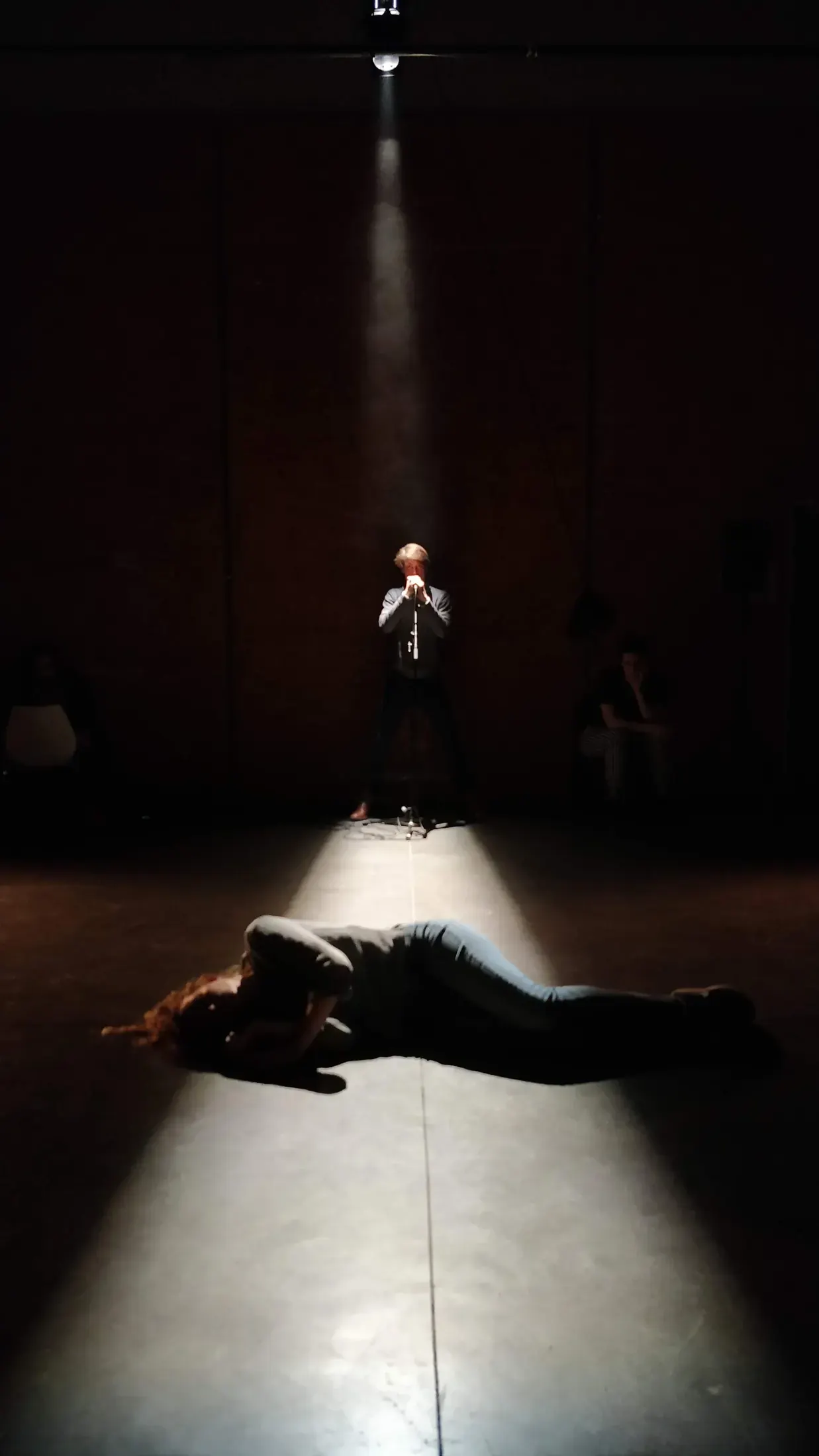
In the theatre, before an opening, we run full run-throughs: the play performed from start to finish without stopping, in the conditions of the evening. Do the same:
- Solo run-through, timed, five times a day in the last week.
- Run-through in front of someone, who takes notes and asks you questions afterwards.
- Run-through in real conditions: standing, with the clicker, slides projected, in a room if possible.
- Hit your time within ten seconds, with a fifteen-second margin on the time you are given.
Also prepare a cut version: if time runs short, you know which part to skip to reach the ask without rushing.
Pitch day
- Arrive early, test the projector, the microphone, the clicker. Have your slides as a PDF on a USB stick and online.
- Warm up your voice ten minutes before, off to the side.
- Listen to the earlier pitches if you can: you will know what the panel has already heard, and which questions they ask.
- Walking on, take two seconds of silence before the first sentence. Settle, look at the panel, then begin.
- During questions, answer briefly, starting with the direct answer.
Nerves lurking? The actors' techniques are in the guide to handling nerves before a pitch. If your cohort has a demo day coming up, see also how to make a pitch, step by step.
Incubators and schools: a workshop for the whole cohort
I also offer the Pitch Workshop: a half-day online session where up to twelve founders work on their pitch before a demo day, with individual feedback for each of them. The details are in the offers section.
To go further, read how to structure an investor pitch and the questions investors ask after a pitch.